
Framing


Hello
I hope all is as well as it can be wherever you are reading this today.
I’m about to take time offline, camping around the coast, mountains and glens of NW Scotland, and revisit a few of my favourite places. I am aware of how ‘behind’ I already feel with BIG (Before I Go) things to be done, and PUOR (Pile Up On Return) things that will be waiting. Some, perhaps even all, of the BIG and PUOR things, when I stop to ponder them properly, are not necessarily essential, and are taking much thought and energy. I know that some of the doing isn’t strictly needed, yet somehow, I feel like I can only have a holiday if I’ve pushed myself beforehand, got anxious about my lack of visibility, done some halfhearted marketing, and responded to a load of emails and cleaned the house! If some BIG things don’t get done, will it matter? What PUORs is my imagination terrorising me with that may have solved themselves and faded away before I unlock my door again on return? What really matters?
My thought ramblings as I move between sorting camping stuff, trying to clear emails (impossible?) and phone notifications (which I swear I turn off every week), has turned to framing. Framing. Putting a shape around almost anything. Particularly thinking. How framing can support us to notice and pay attention. Focussing on what’s in the frame. Being playful with that frame which can take any form, shape, size, material. Imaginary or real. However we frame something, it creates a container for heightened deeper exploration.
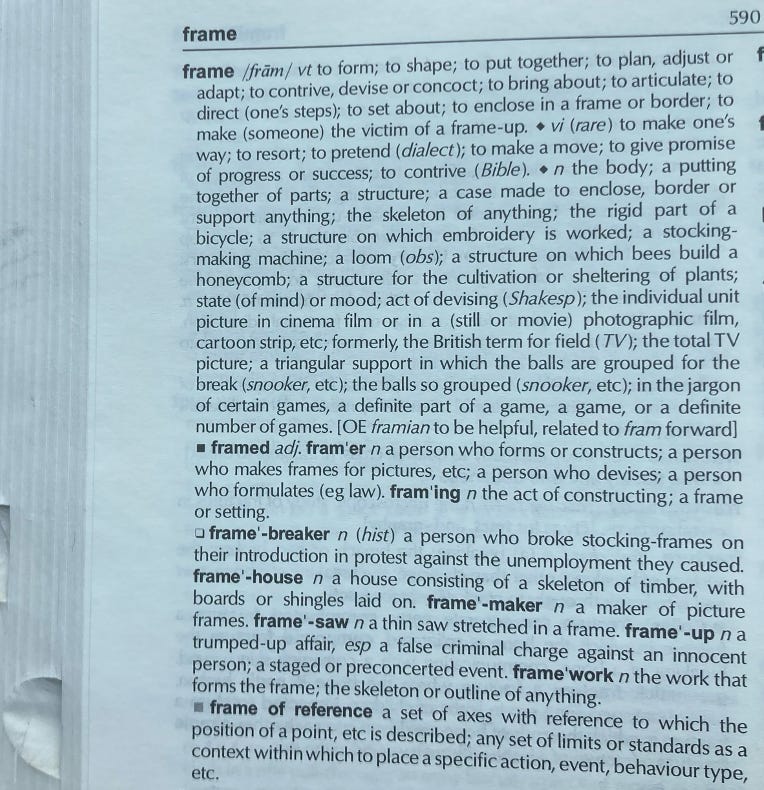
Much of my ‘career’, most of my income, and likely a lot of my personal relationships probably distils down into framing, particularly the framing of a question or questions. We often discuss in the meditation teaching sphere and in the coaching sphere, how vital deep listening is. Framing is vital too. Holding space (framing) in a room for people to communicate, learn off each other, create the yet to be imagined. We frame visual works, frame most of our works and words in the rectangle of our screens (phone, desktop, laptop, etc). I would love to have a circular screen to frame the digital world differently. Maybe it has already been invented. I wonder how framing our digital words and communications through straight lines affects us.
Working as a coach and facilitator, the framing of a good question is an art and a necessary skill. Framing a space for reflection. Knowing when to keep it simple and resist putting multiple frames (or too many questions) on a facilitation process or in a coaching session. Framing may take the form of a visual prompt as a question, an invitation to movement or to stillness, some prior preparation with questions, or a spoken question, or something else that lands as a curious prompt. The framing may be a meditative one and / or a playful one. Attempting to write within this container of a Substack post is another frame.
Thoreau called our heads, ‘the skull-sized kingdom’, and examining that kingdom or realm or queendom or place /space held within our own skull is certainly worth the exploration time. Our ever-so slightly wonky sphere of an earth is another frame or container. How wide a container do we wish to frame with? Where do we naturally place a frame around our thoughts, our doings and beings?
Over the last 35 years in my practice and in work I have used, created and lost many different sets of cards, which form framing prompts made for a widely diverse set of away day, group gathering, happening or research projects. I have made giant cards out of recycling cardboard, with one short curious ask on one side of each card, and the blank side created by the cardboard patterning. I have screwed up tiny pieces of paper each containing one question and encased them in ceramic or knitted nests. I’ve also hidden a few of these outside to become feral and maybe end up with a new inquisitor. Fortune cookies too, are sometimes questions, or prompts rather than straightforward fortunes. I’m not alone in the facilitative space to sometimes use a basic playing card pack for framing an enquiry or making a creative training exercise.
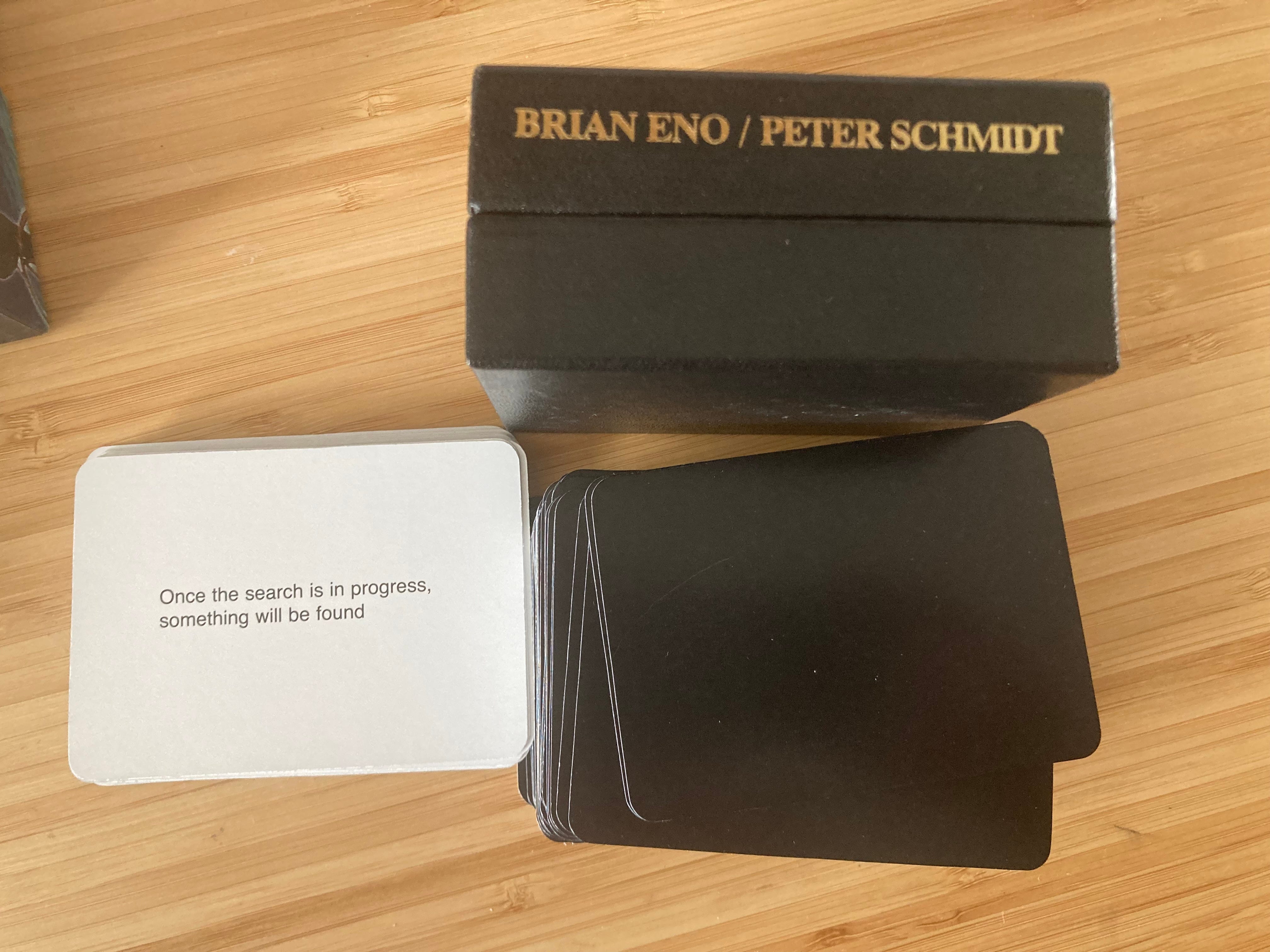
Since art college, I have always had a set of Brian Eno and Peter Schimdt’s Oblique Strategies to hand. Created in 1975 (and now in their fifth edition), the strategies came up in a WhatsApp group conversation recently. Veering off to the side for a second, I would like to big up Peter Schimdt who gets cut out of the conversation most of the time, and people refer to ‘Eno’s Oblique Strategies’. So, Peter Schimdt, thank you for making the strategies with Brian Eno! One of Eno’s diary entries that someone quoted to me at art college was: ‘stop thinking about art works as objects and start thinking about them as triggers for experiences’. What an interesting suggestion and perhaps also framing by card, by other strategy, is also a way of diving into considering the story of experiences and how we narrate those experiences to ourselves and to others.
If Oblique Strategies is new to you, I would recommend trying them as a prompt to alternative ways of getting unstuck, as ways to access new thinking or experiences, or / and as wild conversation starters. Considering something, whether that’s a making project, being stuck, or just a different way to do the washing up… They are sold as ‘whether you are facing creative block or simply looking for a fresh perspective, Oblique Strategies serves as an indispensable companion for navigating the artistic unknown’. I think they’re great for navigating all kinds of unknown. I happened to have the cards with me on a walking coaching day with a longstanding client. They got much joy and unstuckness out of an oblique strategy.
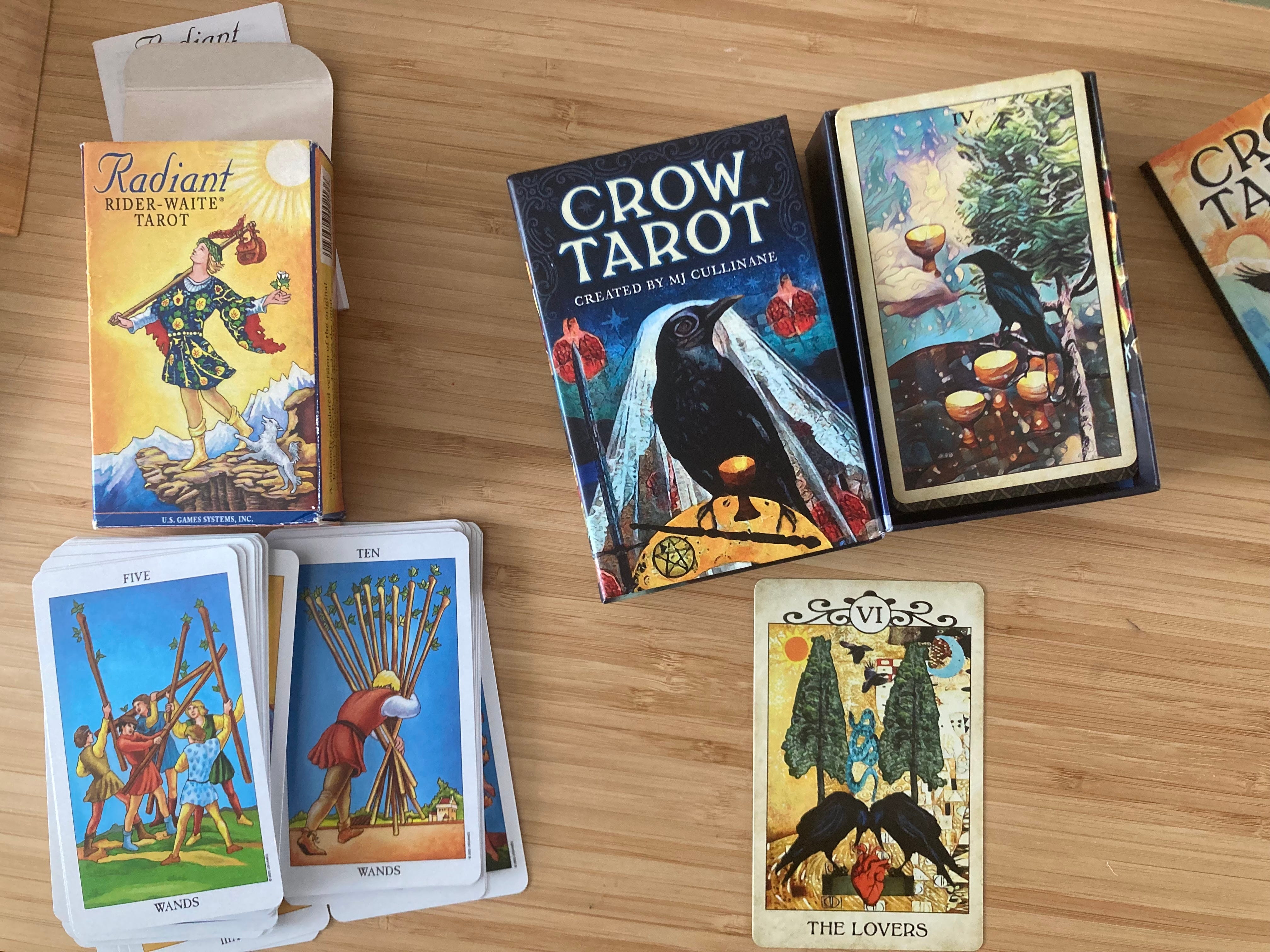
Tarot cards are also having a moment, or maybe I’m just noticing them more now. I own two packs of tarot cards, a radiant (brighter version) of the classic Rider-Waite Tarot; and a Crow Tarot. The Crow Tarot is of course fitting for my love of Corvids. I also started designing a tarot of sorts of my own a very long time ago. This is a long and slow project! Having used tarot from my teenage years, I see the cards as being as useful to curious exploration as any other ways of enquiring, asking questions, prompting, and tarot too is a framing structure. I notice that Meschac Gaba is reading tarot in their Art and Religion Room at Tate Modern this weekend.
I asked Oblique Strategies how do I finish this blog having rewritten it too many times?
The card I picked was:
‘Make an exhaustive list of everything you might do and do the last thing on the list’
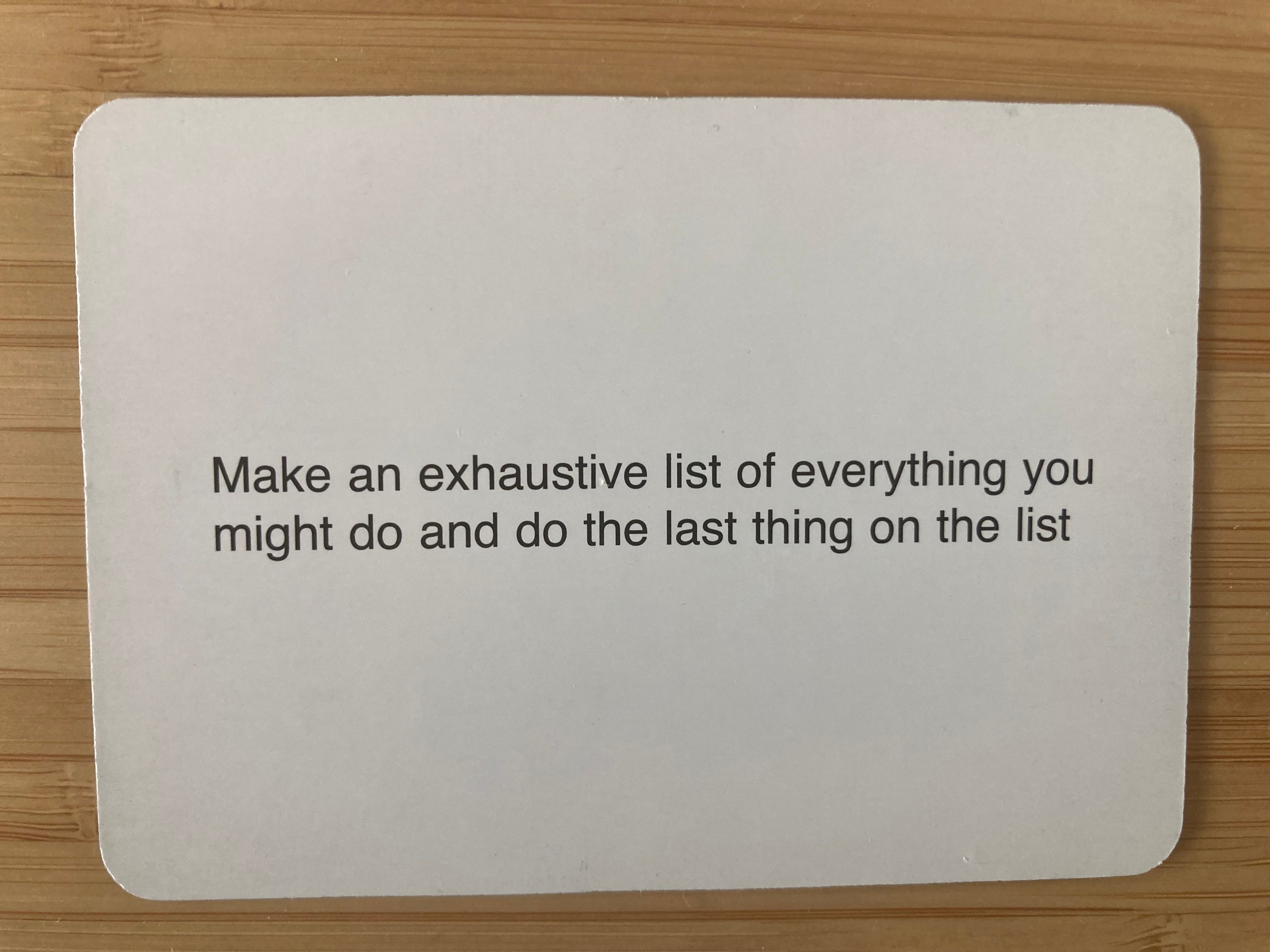
The last thing on my list was swearing at myself to finish this blog. And round I go!
Until next time
With love
Karen
P.s please do click one of the icons (like, comment, restack) and please do share if it sings to you. Thank you.
Wonderful Karen! Just what needed to read today. Thank you x
I'm going to invest in those Oblique Strategies now!